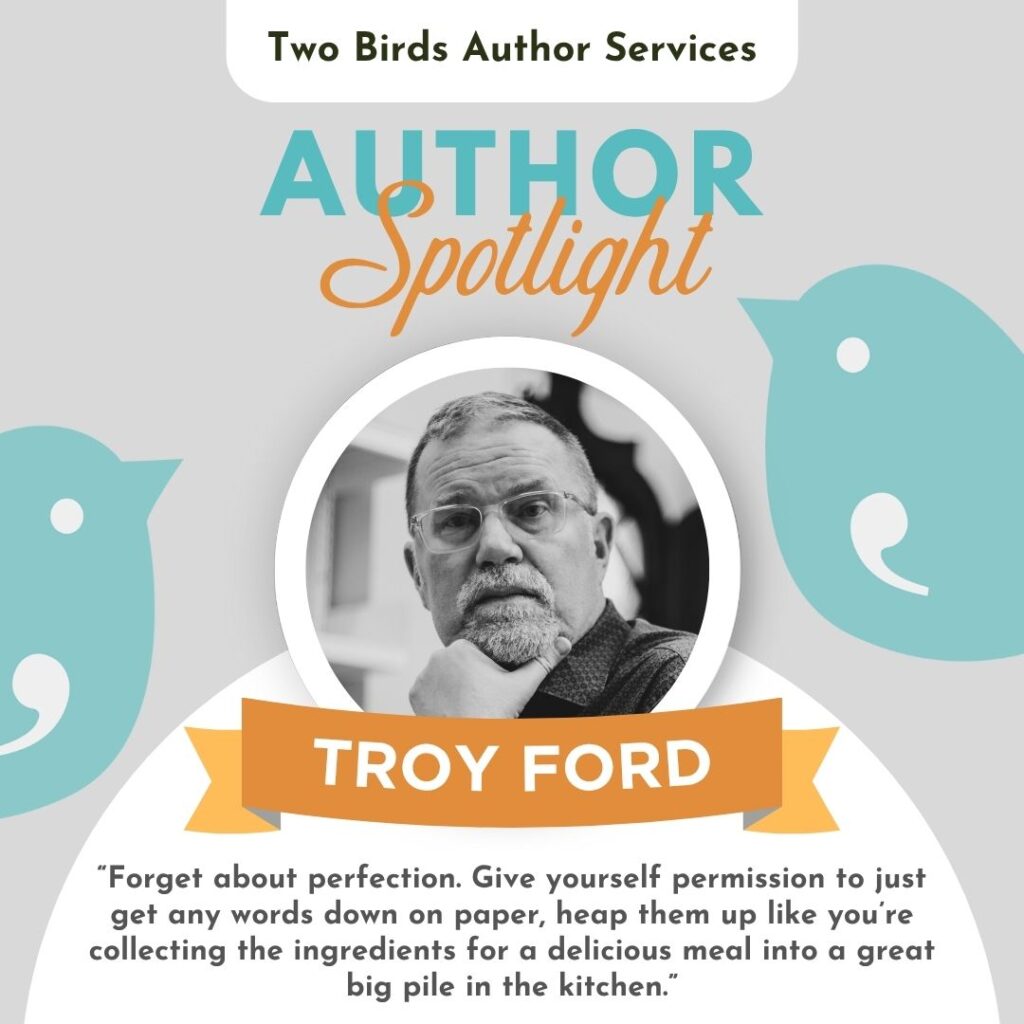
Welcome Troy Ford, author of Lamb!
Tell us a little about yourself! What part of the world do you live in? What do you enjoy doing when you’re not writing?
I was born in Southern California and moved to Saudi Arabia with my family when I was seven. I went to a boarding school near Santa Barbara for high school and settled in the Bay Area after college at UC Berkeley. I was in financial services and interior design for most of my career, then my husband and I moved to Sitges, Spain in 2019, which made it possible for me to focus on writing full-time—something I’d longed to do for almost forty years.
We love to travel—living in Europe means no more 14+ hour plane rides from California to visit family in Rome. And we’re dog people, so Bubba our Amstaff Terrier keeps us busy with walkies and visiting all over town—friends with treats is a big part of our day.
What kinds of books or shows do you enjoy? Do you have a favorite film/TV show/podcast you’d like to share?
I have fairly eclectic tastes in books, TV, and movies, and gravitate toward anything cosy, whimsical, dark, or humorous. Other than all of Arthur Conan Doyle’s Sherlock Holmes stories, I tend to consume books on a case-by-case basis rather than finding an author I love and reading all their work. Favorite oddities in fiction include Elspeth Barker’s O Caledonia, Roberto Bolaño’s Distant Star, John Fante’s Arturo Bandini books, William Trevor’s The Story of Lucy Gault, and John Crowley’s Little, Big.
I like to watch science fiction but not read it (Star Wars and Star Trek, naturally). I’m eagerly (though frustratingly) awaiting Season 2 of Netflix’s 3 Body Problem. Love British crime or spy dramas. Love a good apocalypse or zombie movie.
Favorite podcasts and YouTube shows are K Anderson’s Lost Spaces, Shawn Moody’s Shawn Breathes Books, and genXy’s The Daily Whatever.
What inspired you to start writing fiction? And how did you end up choosing your specific genre(s)?
I loved to read when I was a kid, always with a book in hand. By the time I read Harriet the Spy and realized that through writing I could combine my love of reading with the exquisite intrigue of observing the crazy things people do, I knew the writing life was for me.
At first I imagined fantasy was my genre, because I loved The Lord of the Rings and wanted to create my own world as Tolkien had. But nearly three decades of writer’s block after a disastrous experience at a creative writing course in high school eventually led me to try something which resonated emotionally for me, so contemporary queer fiction is where I’ve landed.
What’s your most recently published book? What genre is it, and what’s it about? Is it part of a series?
I just released my debut, Lamb: A novel in snapshots. It’s a queer coming-of-age story of two friends from high school through their twenties until the title character ghosts the narrator, the unnamed “D”, who spends the next twenty years wondering what happened and who his sweet but misunderstood friend really was. It’s experimental—the “snapshots” are recollections, short stories, letters, and journal entries D finds in the boxes Lamb left behind.
After attending the Indie Unconference 2025 in Matera, Italy in June—where I was welcomed into a very kind and experienced cohort of independent authors—I’ve decided to continue the Lamb story, hopefully with two new novels exploring D’s life after Lamb, and the missing three years of Lamb’s life after he disappears.
What has been the most challenging part of being an indie (self-pubbed) author? How have you tackled that challenge?
Other than overcoming a thirty-four-year writer’s block? Probably the part where a single person must try to produce a quality book without the built-in assistance and tools of a publishing house. Editing, proofreading, formatting, book covers, publishing/distributing, marketing, and advertising—to name just a few pieces of the puzzle—each one is a field in itself. The learning curve is steep. Two Birds can help.
At some point I just set a budget for absolute musts like marketing and cover design, and committed to doing the work that was left over myself. Everything can be fixed later if necessary when you’ve got more money and more experience.
What has been the most fulfilling part of being an author?
The simple challenge of writing a book calls on every part of your creative and intellectual power. Finishing a book after believing for so long that I couldn’t was the most satisfying and empowering accomplishment of my life.
Tell us a bit about your process. Do you write every day? Do you have a specific coffee shop where you write?
I’m always writing, but not always my books. I’ve got two newsletters—Ford Knows Books and Qstack, the LGBTQ+ Directory of Substacks—so a lot of my time goes into putting out editions of those, writing articles, introductions to other people’s work, and so forth. I wish there were more coffee shops or cafes in our town conducive to long dreamy writing sessions, but most of them tend to be quite loud and sociable, so everything happens at home in my office on my computer.
Any time I do have something specific to write, though, I set myself the goal to write every weekday for at least ten minutes. That seems quite short, and it is, but I’ve found my biggest problem is procrastination, just getting going. I can always trick myself into sitting down and writing for ten minutes; it usually turns into an hour, and that’s 700 to 1000 words easy. Do that every weekday for four or five months, and you’ve got the messy rough draft of a novel.

What tips do you have for other authors working on their books? Anything you’ve learned that you’d like to share with newer authors?
Forget about perfection. Forget about craft when you’re drafting. Most new writers get bogged down in comparing the pages they’re currently working on with the output of published authors, and that’s a formula for getting stuck. Give yourself permission to just get any words down on paper, heap them up like you’re collecting the ingredients for a delicious meal into a great big pile in the kitchen. The real cooking (craft) doesn’t start until you’ve got all your ideas out of your head and onto the page.
What is the most helpful tip you can offer to authors who, like you, want to find the right editor for their books?
Ask for the sample edits, and really look at the tone and quality of the advice given to previous clients. An editor is also a reader; if they don’t get something or feel like something isn’t ringing true in your story, their perspective might require you to rethink big parts of your book. Be open to that possibility—it’s a lot of work, but it will make you a better writer.
Where can authors and readers connect with you, and find your books? (Please provide links to your social media, website, or any place you want to share with our readers)
Lamb by Troy Ford is available as an ebook on Amazon, and in paperback on Amazon, Barnes and Noble, Bookshop.org, and through your favorite bookstore.
You can subscribe to my newsletters for free: Ford Knows Books and Qstack.
I’m on Instagram, Threads, Bluesky, Facebook, and reluctantly, on X.
My website is troyfordauthor.com.